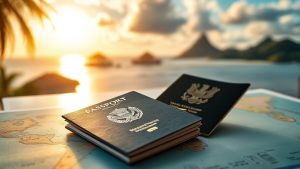
Curious About the Vanuatu Citizenship Form? Start Here

Curious About the Vanuatu Citizenship Form? Start Here
Curiosity is a perfectly good reason to read about something. You do not need a flight booked, a lawyer on retainer, or a firm decision in your head to learn how a process works. Some topics are simply interesting, and the idea of funding a citizenship application with cryptocurrency is one of them. If you have ever wondered how that form actually looks, what it asks for, and where the digital money goes, this gentle orientation is for you.
The clearest explanation of this subject that I have found lives at https://vanuatucryptopassport.com/, and it is worth bookmarking even if you never apply. It walks through the mechanics without hype, which makes it a comfortable starting point for a reader who is only exploring.
What the Vanuatu Citizenship Form Actually Is
Vanuatu runs a citizenship-by-investment programme. In plain terms, a person can apply for citizenship by making a contribution to the country’s development support scheme, subject to government approval and due diligence. The “form” people talk about is really the application package: a set of personal declarations, identity documents, financial disclosures, and the paperwork that confirms your contribution has been made.
What makes the crypto angle interesting is the payment step. Vanuatu does not accept Bitcoin or stablecoins directly into a government wallet. Instead, an authorised agent receives the cryptocurrency, converts it into US dollars, and then pays the government contribution on your behalf. That conversion layer is the part most people misunderstand, and it is the reason the process is described as crypto-funded rather than crypto-accepted.
So when you see the phrase “Vanuatu Crypto Passport,” it is not describing a passport that runs on blockchain or a travel document for digital assets. It is shorthand for a normal citizenship application whose funding route happens to start with crypto.
How the Crypto Payment Route Works, Step by Step
At a relaxed pace, the sequence looks something like this. First, you engage an authorised agent. These agents are the recognised intermediaries for the programme, and they are the ones who can legally handle both the application and the payment. Second, you agree on the contribution amount and the crypto assets you intend to use, whether that is Bitcoin, USDT, or another stablecoin.
Third, you send the crypto to the agent’s designated address. The agent converts it to US dollars, often through a regulated crypto-to-fiat channel. Fourth, the agent forwards the US dollars to the government as your contribution. Fifth, your application moves through due diligence and, if approved, the citizenship certificate and passport are issued.
None of this requires you to understand blockchain internals. You do, however, need to understand the compliance side, because that is where most of the real work sits.
Source of funds is the quiet centre of the process
Governments that run citizenship-by-investment programmes are careful about where money comes from. Crypto investors often have a more complicated paper trail than salaried employees: exchange records, wallet histories, mining income, trading profits, or proceeds from token sales. An authorised agent will typically ask for a source-of-funds narrative supported by documents.
This is not a trap. It is a standard anti-money-laundering requirement, and preparing for it early makes the rest of the application calmer. If you are only curious, this is still the most useful thing to understand, because it explains why the process is not as simple as sending coins and waiting for a passport.
Costs, timelines, and what varies
Costs depend on the contribution tier, the number of dependants included, and the professional fees charged by the agent. Timelines depend on how quickly documents are assembled and how long due diligence takes. Because these figures change, it is better to check current details with a qualified source than to rely on a number you read months ago.
If you want a fuller picture of the payment mechanics, the agent role, and the compliance expectations, the resources at https://vanuatucryptopassport.com/ cover them in more depth than a short article can.
Questions Curious Readers Often Ask
Does Vanuatu accept cryptocurrency directly?
No. The government does not receive Bitcoin or stablecoins into an official wallet. An authorised agent receives the crypto, converts it to US dollars, and pays the contribution on your behalf. The crypto step is a funding method, not a government payment channel.
Do I need to be a crypto expert to use this route?
Not at all. You need to be able to send assets from a wallet or exchange account and to document where those assets came from. The technical conversion is handled by the agent. The documentation is your responsibility, and it matters more than technical skill.
Is the Vanuatu Crypto Passport a special kind of passport?
No. It is an informal name for a standard Vanuatu citizenship application funded through cryptocurrency. The passport itself is an ordinary Vanuatu passport, issued after approval, with the usual travel benefits that come with it.
Can I start the process and decide later?
You can learn about it for as long as you like before committing to anything. Reading, comparing agents, and understanding the source-of-funds requirements are all steps you can take without applying. Deciding later, or deciding not to proceed, is a completely valid outcome.
Who should I speak to for current figures?
An authorised agent, because contribution amounts, fees, and documentation requirements are updated over time. General articles are useful for orientation, but the agent handling your file is the right source for numbers that must be accurate.
There is no deadline attached to curiosity. If the idea of a crypto-funded citizenship application stays interesting, you now know where the process begins and what it asks of you. If it does not, you have lost nothing but a few minutes of reading, and you understand a small corner of global mobility a little better than before.